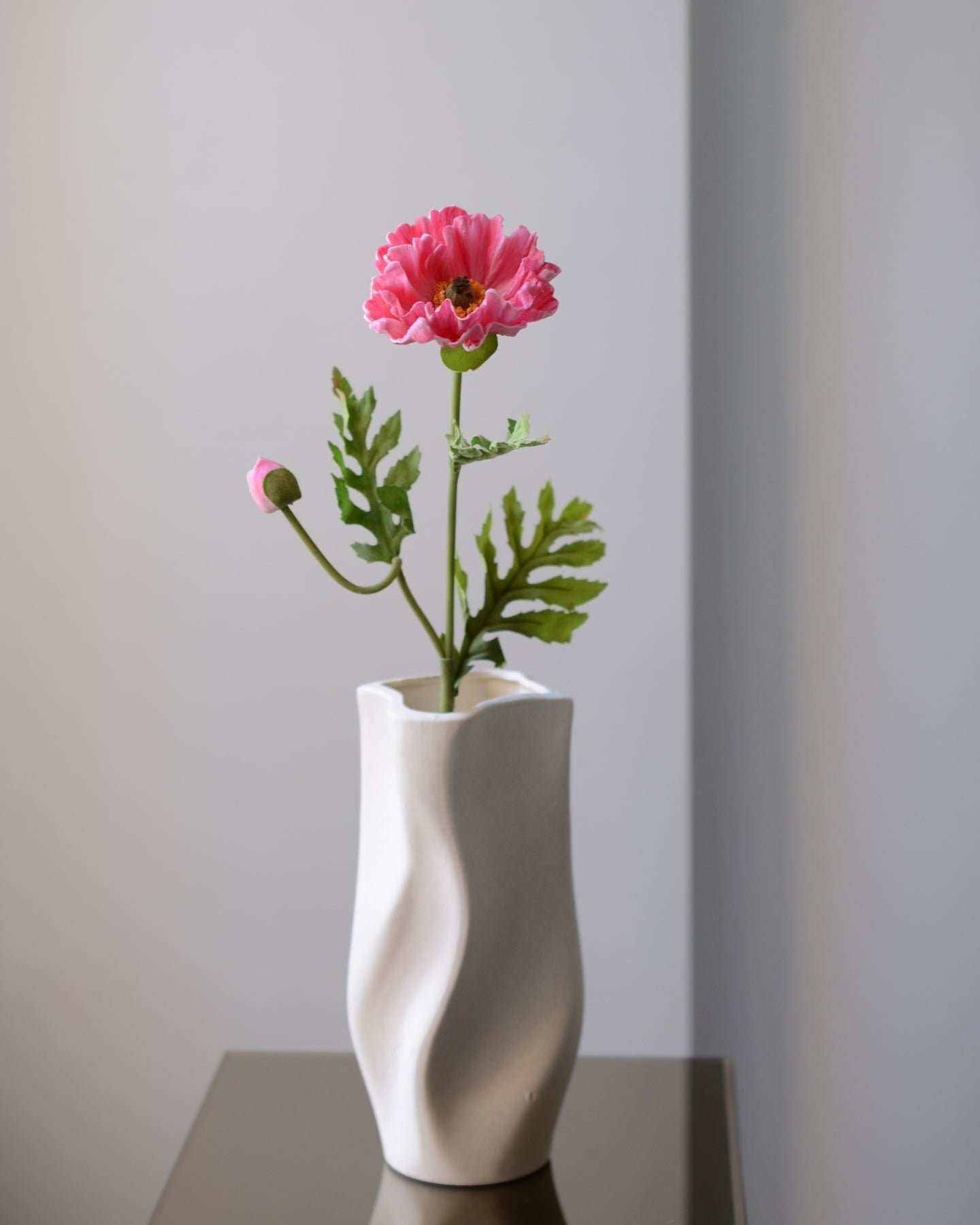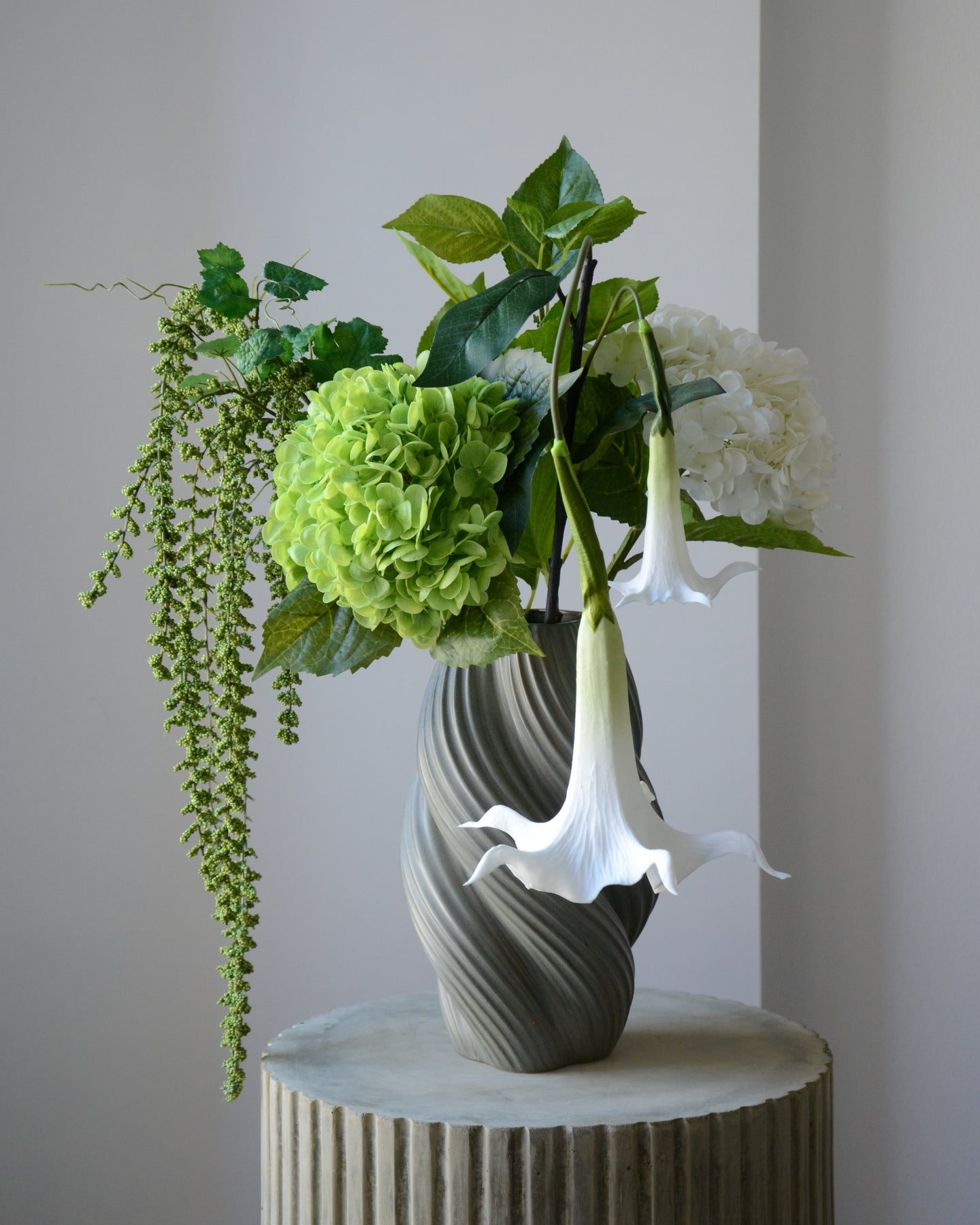


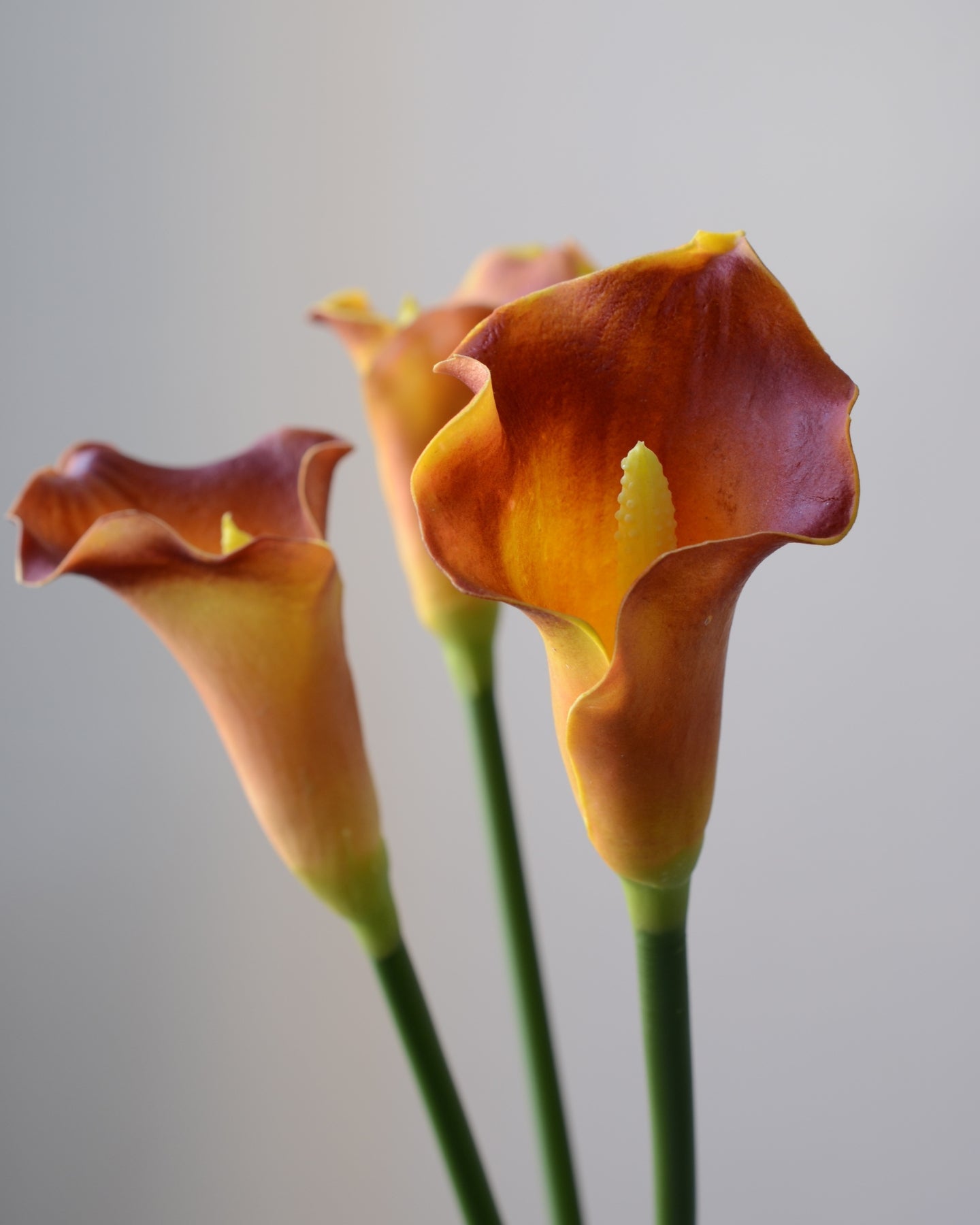
A real petal is never just one colour. Look closely at a hydrangea and you will usually find several shades, from the centre out towards the edge, with light filtering through the petals rather than simply stopping at the surface.
That is part of what a good artificial flower needs to recreate. It is also part of the reason why some cost forty kroner while others cost two hundred.

What is real touch
Real touch is not a specific material. It is a term used for a type of artificial flower designed to recreate both the look and feel of a living flower.
Many real touch flowers are made from polyurethane, sometimes combined with latex, and moulded into a thin surface with the soft, slightly yielding feel of a real petal. Press it gently between two fingers and it gives way before returning to its shape.
The term is now used broadly and can refer to several different materials and production methods. Real touch is therefore not, in itself, a guarantee of quality. What matters is how the material is used and how convincingly the flower is reproduced.
It is in the details
A good artificial flower starts with a real one. Its shape and structure can be scanned or pressed from a fresh petal, so the veins and details come from nature rather than from a drawing.
The pigment is mixed into the material before the petal is moulded. This means the colour becomes part of the material itself rather than simply sitting on the surface. The petal is then shaped to give it the natural curve and movement that make a flower feel alive.
A single peony head can contain more than fifty petals. When each individual petal has to be shaped, the flower assembled and everything placed by hand, it quickly becomes clear how much craftsmanship goes into a well-made stem.


Why some look real and others don’t
What gives an artificial flower away is rarely the material alone. It is the lack of variation.
Real flowers are irregular. Petals curve in different ways, colour varies across the flower, and no two flowers are exactly alike. Cheaper artificial flowers often repeat the same shape and saturated colour because uniformity is cheaper to produce. It is precisely that perfection that makes them look artificial.
Good production works in the opposite direction. Colour graduates from the centre towards the edge rather than remaining uniform throughout. The material is kept slightly translucent, allowing light to pass through the petal. Veins and surface details create subtle shadows, while the finish is kept matte rather than glossy.
Often, it is the small irregularities that make the biggest difference.
Other materials
What is sold as silk rarely contains actual silk. It is typically polyester stretched over a wire frame and makes up a large proportion of the artificial flowers produced. It takes colour well and can be shaped into many different forms, so it still works beautifully for certain flowers. But the material is more opaque and can fray with handling.
Foam is lightweight and holds its shape well, which makes it useful for larger decorative flowers. The downside is that it can develop marks and dents that may be permanent.
UV-treated polyethylene is used primarily for foliage and outdoor arrangements, where durability and resistance to sunlight matter more than the feel of the material. It is robust and stable, but it also feels more like what it is.
None of these materials is inherently wrong. They are suited to different purposes. The question is whether the material has been chosen to reproduce the flower as convincingly as possible, or simply to keep the price down.

Fresh hydrangea on the left. Bloomgaard on the right.
The stem
The stem does more for a flower than you might think. A wire core is what allows an arrangement to be shaped rather than simply assembled. A stem that cannot bend will often look unnatural in a bouquet.
This is also where cheaper production often becomes obvious. An unnaturally bright green stem, glossy materials and leaves placed at identical intervals can make even a well-made flower look artificial.
A good stem should do more than support the flower. It should be flexible enough to move and be shaped organically, becoming part of the arrangement rather than simply holding the flower upright.
Which flowers are easiest to reproduce
Some flowers are much easier to reproduce convincingly than others.
Peonies and garden roses work well because their fullness hides the joins, and the real flowers already have a naturally imperfect quality. Hydrangeas work for the same reason, provided the individual florets vary in shape and colour rather than repeating themselves.
Orchids and anthuriums are also good candidates. Their petals are naturally thick and waxy, with a sculptural quality that is easier to reproduce.
Tulips are among the more difficult. Much depends on the stem, which needs to have the natural curve of a real tulip without looking glossy or too perfect.
Flowers with a simple structure and very thin petals are the most unforgiving. When there are fewer details for the eye to take in, there is also less to disguise the small differences between an artificial and a real flower.